


Overview of Systemic Coaching Methods
What Really Works – and Why.


Coaching is more than the sum of its methods.
But using the right systemic methods at the right moment makes the difference between good coaching and excellent coaching. Here you’ll find an overview of the methods and tools from the systemic toolkit that I use most frequently—with notes on when and why they work.
Coaching is more than just methods – but they do help.
Systemic coaching considers people as part of a whole—including relationships, patterns, beliefs, and values. A meta-analysis by Lotte et al. shows that the relationship between the coach and the coachee is the single most important factor in the success of coaching. The methods play a smaller but crucial role—provided they are a good fit for the coachee and the topic. The right methods turn good coaching into excellent coaching.
The following list is constantly growing. If you’re thinking about starting coaching with me, I recommend taking the Inner Drivers self-assessment or exploring your Inner Saboteurs beforehand—both are good starting points for later work on beliefs and values.
Step out of your head, into your feelings—Systemic Structural Constellations
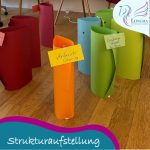
“That’s spooky.” Or something along those lines is how coachees often react to one of my favorite coaching methods: the structural constellation.
When people come in for coaching, they’ve usually been mulling over their topic for a long time—and in doing so, they find themselves stuck in the same mental loop over and over again. Staying on the cognitive level and thinking the same thoughts for the thousandth time rarely yields anything new. It’s more helpful to let the coachee tap into their feelings—and to let their “gut” speak for once. It often has a lot to say.
Structural constellations are ideal for this. Unlike in family constellations, no people are represented here; instead, all aspects of an topic are represented—including placeholders for aspects that are still unconscious. As the individual “stations” are run through and described, the topic literally comes to life. The puzzle pieces can be viewed from different angles and rearranged. A new picture emerges—and the pieces often fall into place almost on their own.
The most remarkable aspect of this method is that coachees experience a clarity they did not previously possess on a cognitive level—as if “the veil has been lifted from their eyes.” It is precisely this “aha” moment that often marks the beginning of genuine change.
Particularly helpful for: Be YOU—career or personal orientation processes where gut feelings should play a role.
A Change of Perspective Instead of Internal Dialogue – Circular Questions
“What would your best friend say if I asked her how you’re really doing right now?”
That’s a circular question—and it often works better than the direct version. When I ask you, “How are you?” you’ll likely answer based on the self-image you project to the outside world. But when I mentally invite your best friend to speak, the answers are often very different—more honest, sometimes more uncomfortable, and almost always more revealing.
Circular questioning is one of the most important tools in systemic work. Instead of asking directly about feelings, opinions, or explanations, the coach shifts the perspective: “What would your boss say you’re particularly good at when it comes to this task?” – “How would your daughter talk in ten years about the decision you’re making today?” – “If you were in my shoes, what else would you ask right now that I haven’t asked yet?”
Such questions bypass the inner censor and open up spaces that would remain closed off by direct questions. They bring hidden assumptions, relationship dynamics, and self-images into conscious awareness—often with surprising clarity.
Particularly helpful for: Be Strong and Be YOU—when self-images and others’ expectations become entangled.
Coming to Terms with Yourself – The Inner Team

You’re probably familiar with the image of the little devil and the little angel sitting on the hero’s shoulders in old movies, whispering in his ear. Much of this is true—we all have such inner voices—but the idea suggests that one of them is evil and wants to cause harm.
In coaching, these voices are called the inner team. They represent different needs that sometimes come into conflict. Together, they make up our personality.
Here’s an example: One voice wants you to exercise to stay fit. The other wants you to recharge because there’s already so much to do. We often call this second voice, out of frustration, the “sloth”—but it, too, has a positive intention. It wants what’s best for us: rest. We just often don’t see it that way.
As long as we fight this voice, we won’t be able to silence it—because it expresses a genuine need. A better approach is to recognize the positive intention behind the voice, acknowledge the need, give it a friendly name (for example, “the wellness manager”), and finally negotiate how both needs can be met. That is the actual work of coaching.
Particularly helpful for: Be Strong—internal conflicts between conflicting needs.
Reevaluating Situations and Behavior – Reframing

“You’re such a terrible stubborn person!” – “Oh, thank you for the compliment—I’m just consistent!”
Have you ever responded to a criticism like that? If so, you’ve surely experienced an interesting reaction. Putting behavior that’s perceived as negative into a positive context is called reframing. The underlying principle is that there’s a positive intention behind every behavior—we just have to discover it.
There are two forms of reframing:
Meaning reframing. Finding a different meaning for the same behavior. Characteristic: “Whenever X, then Y”—a cause-and-effect relationship. Question: What else could this mean? Example: “I suffer a loss because of an employee’s mistake.” → “I’m investing in their training.” (attributed to Henry Ford)
Context reframing. Finding a context in which an unwelcome trait is useful. Characteristic: “I am too X”—the behavior becomes part of one’s identity. Question: In what situation is this useful? Example: “I’m too slow” → “I work thoroughly.”
The effect: The focus shifts to advantages and positive intent—and thus to reconciliation with oneself or the other person. With a little practice, reinterpretation quickly becomes a habit.
Particularly helpful for: Be Strong—self-criticism and difficult relationships.
Letting Go of Limiting Beliefs – The Values and Development Square
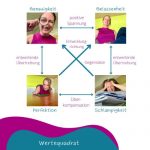
The opposite of perfection is sloppiness. At least, that’s the limiting belief held by many perfectionists. Perhaps it’s yours, too?
Anyone who’s ever tried to change a behavior knows the feeling: You promise yourself you won’t check the presentation for the thousandth time, but will go to bed early instead—and yet you still can’t do it. Or if you do, it’s with a guilty conscience. The reason lies in the “opposite value” we have in mind. With perfectionism, we think of sloppiness—and nobody wants to be sloppy.
Schulz von Thun’s Values and Development Square shows that for every extreme, there is a positive underlying value. With perfectionism, that value is precision—in other words: checking things thoroughly, but not all night long. And there’s a positive value for the supposed opposite: in this case, serenity. Both represent possible paths for growth if your own behavior bothers you.
The path to growth:
– What value lies behind your behavior?
– What would be the supposed opposite?
– Which of the two is exaggerated? (Probably the first.)
– What would be the positive, non-exaggerated value associated with it?
– In which direction would you like to grow?
The Values Square is an ideal tool for working on values and beliefs.
Particularly helpful for: “Be Strong” and “Be YOU”—self-improvement that becomes a trap.
Changing Behavior & Emotions – Anchoring
You’ve probably lost your temper at some point, even though you’d promised yourself you wouldn’t fly off the handle in a certain situation. We’ve all been there. The moment a familiar trigger arises, all your resolutions are forgotten—and the usual response pattern kicks in almost automatically.
One method many people are familiar with is taking a deep breath. If you manage to pause for a moment, you’ll usually react in a more relaxed way. The problem is that we often miss that very moment of pause.
An additional help is to set an anchor in advance—a physical signal that triggers a helpful emotion:
– What emotion or feeling would help in that moment?
– Sense whether that emotion would really make a difference in the situation.
– Find a situation in which you experienced this emotion strongly.
– Put yourself in that situation and relive it with all your senses.
– At the peak of that experience, set a physical anchor—for example, pressing two fingers together.
– Practice—even in your imagination.
– Consciously activate the anchor the next time a critical moment arises.
Particularly helpful for: Be at Peace—impulsive reactions under pressure.
Creating New Possibilities – The “Miracle Question” and the Merlin Method
“I live my life from the future toward the past.” – Merlin
Have you ever tried it? With the Merlin Method, you plan backward: from the goal to the starting point. Here’s how it works:
– Paint a colorful mental picture of your goal.
– Imagine that you’ve already achieved it.
– Sense how that feels—and all the possibilities it opens up.
– What was the last step before you reached your goal?
– And the step before that?
– And before that?
– What obstacles did you overcome along the way—and how?
To spark your imagination, picture a reporter interviewing you about your success—or imagine you’re sitting with your team at a celebration party, looking back together.
Why this works: Instead of asking, “Is this possible?” ask, “How can this be done?”—this makes the conversation solution-oriented. While there are many possible first steps, there’s usually only one final step—which reduces discussions about the right path. And a clear mental image of the goal ensures motivation and unity among everyone involved.
In coaching, this idea is often used as the “miracle question” (Steve de Shazer): “Imagine you fall asleep, and overnight a miracle happens—your problem is solved. What’s the first thing you notice when you wake up? How does it feel?”
Particularly helpful for: Be YOU—when old paths feel stuck and new possibilities need to be found.
Breaking Free from Stuck Decisions – The Tetralemma
When people come to coaching with a decision to make, it’s rarely “Should I choose A or B?” More often than not, it’s: “I can’t decide between A and B—no matter how many times I think it through.” In such cases, it’s pointless to keep weighing the two options against each other. Instead, the Tetralemma broadens the field to four positions—plus a fifth that changes the game:
The One—Option A in all its consequences
The Other—Option B in all its consequences
Both—What if both options could be true at the same time?
Neither—What if neither of the two options is the right question?
None of the above—and not that either—the position beyond the previous logic, which makes something completely new possible
Coachees usually set up these positions in the room and physically walk through them. What sounds like mere semantics becomes surprisingly concrete when experienced: Position 3 (“Both”) often reveals that the seemingly contradictory options share a common core. Position 4 (“Neither”) reveals that the question itself was framed incorrectly. And the fifth position opens up space for a solution that one would never have arrived at starting from A or B.
The Tetralemma originated in Indian logic and was adapted for use in systemic work by Matthias Varga von Kibéd and Insa Sparrer.
Particularly helpful for: Be YOU – decision-making situations where the usual “pros and cons” approach doesn’t help.
Additional Methods Beyond the Classical Systemic Methodology

Sometimes an issue requires more than systemic work—whether it’s body-centered emotional work, a quantitative values analysis, or an animal serving as an impartial mirror. I have dedicated separate pages to these methods:
Brainlog® – a body-centered method for resolving deep-seated stress patterns.
Profile Dynamics® / Spiral Dynamics – quantitative values analysis based on the research of Clare Graves.
Horse-Assisted Coaching – horses as an honest mirror for authenticity, presence, and leadership.
Positive Intelligence® – mental fitness, also available as an app-based six-week program.
Which method is right for your topic?
During a free Discovery Call, we’ll explore together which methods will best support you on your journey.